
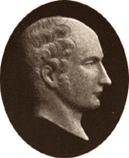


Chapter III: Of Individuality, as One of the Elements of Well-Being
SUCH being the reasons which make it imperative that human beings should be free to form opinions, and to express their opinions without reserve; and such the baneful consequences to the intellectual, and through that to the moral nature of man, unless this liberty is either conceded, or asserted in spite of prohibition; let us next examine whether the same reasons do not require that men should be free to act upon their opinions—to carry these out in their lives, without hindrance, either physical or moral, from their fellow-men, so long as it is at their own risk and peril. This last proviso is of course indispensable. No one pretends that actions should be as free as opinions. On the contrary, even opinions lose their immunity, when the circumstances in which they are expressed are such as to constitute their expression a positive instigation to some mischievous act. An opinion that corn-dealers are starvers of the poor, or that private property is robbery, ought to be unmolested when simply circulated through the press, but may justly incur punishment when delivered orally to an excited mob assembled before the house of a corn-dealer, or when handed about among the same mob in the form of a placard. Acts of whatever kind, which, without justifiable cause, do harm to others, may be, and in the more important cases absolutely require to be, controlled by the unfavourable sentiments, and, when needful, by the active interference of mankind. The liberty of the individual must be thus far limited; he must not make himself a nuisance to other people. But if he refrains from molesting others in what concerns them, and merely acts according to his own inclination and judgment in things which concern himself, the same reasons which show that opinion should be free, prove also that he should be allowed, without molestation, to carry his opinions into practice at his own cost. That mankind are not infallible; that their truths, for the most part, are only half-truths; that unity of opinion, unless resulting from the fullest and freest comparison of opposite opinions, is not desirable, and diversity not an evil, but a good, until mankind are much more capable than at present of recognizing all sides of the truth, are principles applicable to men's modes of action, not less than to their opinions. As it is useful that while mankind are imperfect there should be different opinions, so is it that there should be different experiments of living; that free scope should be given to varieties of character, short of injury to others; and that the worth of different modes of life should be proved practically, when any one thinks fit to try them. It is desirable, in short, that in things which do not primarily concern others, individuality should assert itself. Where, not the person's own character, but the traditions of customs of other people are the rule of conduct, there is wanting one of the principal ingredients of human happiness, and quite the chief ingredient of individual and social progress. 1
In maintaining this principle, the greatest difficulty to be encountered does not lie in the appreciation of means towards an acknowledged end, but in the indifference of persons in general to the end itself. If it were felt that the free development of individuality is one of the leading essentials of well-being; that it is not only a co-ordinate element with all that is designated by the terms civilization, instruction, education, culture, but is itself a necessary part and condition of all those things; there would be no danger that liberty should be undervalued, and the adjustment of the boundaries between it and social control would present no extraordinary difficulty.
|
|
|
|
コメント(10)
As it is useful that while mankind are imperfect there should be different opinions, so is it that there should be different experiments of living; that free scope should be given to varieties of character, short of injury to others; and that the worth of different modes of life should be proved practically, when any one thinks fit to try them.
人類が不完全である間は異なった意見があることは有益であるのと同様に、生活の異なった実験もまた有益であり、他人への害が少ない限り自由な行動がさまざまな性格に与えられる事、そして人がそれらを試したいと言う思いを持つ時、異なった生活のやり方の価値が実際的に証明されることは共に有益です。
人類が不完全である間は異なった意見があることは有益であるのと同様に、生活の異なった実験もまた有益であり、他人への害が少ない限り自由な行動がさまざまな性格に与えられる事、そして人がそれらを試したいと言う思いを持つ時、異なった生活のやり方の価値が実際的に証明されることは共に有益です。
Chapter III: Of Individuality, as One of the Elements of Well-Being 幸福の一つの要素としての個性について
SUCH being the reasons which make it imperative that human beings should be free to form opinions,
以上述べたようなものが人間は意見を形作る自由を持つことが避けられないものとする理由であり、
and to express their opinions without reserve;
留保なく彼らの意見を表現する自由についての理由であり、
and such the baneful consequences to the intellectual,
そして、以上述べたことは、知性に対しての有害な結果であり、
and through that to the moral nature of man,
また、それを通して、人間の道徳的な性格に対する有害な結果であり、
unless this liberty is either conceded, or asserted in spite of prohibition;
この自由が容認されるか、あるいは禁止されたにもかかわらず、主張されるかしない限り、(→先に述べた有害な結果が出るので)
let us next examine whether the same reasons do not require that men should be free to act upon their opinions—to carry these out in their lives,
この、同じ理由付けが、人々は彼らの意見に従って行動する自由があること、つまり、彼らの人生においてその意見を実行に移す自由を有する、ということを要求するかについて検討する。
without hindrance, 妨害なくeither physical or moral,物理的にも精神的にも from their fellow-men,周囲の人々から so long as it is at their own risk and peril.それが彼ら自身の意図による冒険と、彼ら自身が受ける危険とを覚悟してなされる限り。
SUCH being the reasons which make it imperative that human beings should be free to form opinions,
以上述べたようなものが人間は意見を形作る自由を持つことが避けられないものとする理由であり、
and to express their opinions without reserve;
留保なく彼らの意見を表現する自由についての理由であり、
and such the baneful consequences to the intellectual,
そして、以上述べたことは、知性に対しての有害な結果であり、
and through that to the moral nature of man,
また、それを通して、人間の道徳的な性格に対する有害な結果であり、
unless this liberty is either conceded, or asserted in spite of prohibition;
この自由が容認されるか、あるいは禁止されたにもかかわらず、主張されるかしない限り、(→先に述べた有害な結果が出るので)
let us next examine whether the same reasons do not require that men should be free to act upon their opinions—to carry these out in their lives,
この、同じ理由付けが、人々は彼らの意見に従って行動する自由があること、つまり、彼らの人生においてその意見を実行に移す自由を有する、ということを要求するかについて検討する。
without hindrance, 妨害なくeither physical or moral,物理的にも精神的にも from their fellow-men,周囲の人々から so long as it is at their own risk and peril.それが彼ら自身の意図による冒険と、彼ら自身が受ける危険とを覚悟してなされる限り。
- mixiユーザー
- ログインしてコメントしよう!
|
|
|
|
ミル自由論 更新情報
-
最新のイベント
-
まだ何もありません
-
-
最新のアンケート
-
まだ何もありません
-
ミル自由論のメンバーはこんなコミュニティにも参加しています

人気コミュニティランキング

- 1位
- 暮らしを楽しむ
- 77506人
- 2位
- 食べ物写真をつい撮ってしまう人
- 19997人
- 3位
- 一行で笑わせろ!
- 83085人