
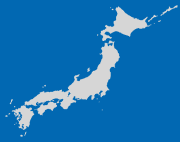


最近の事件でいくつか気になることがあります。
「犯罪を起こして、さらに犯人は被害人に対して、謝れ」ということ?
最悪の事態が起きていると思います。
「China on Saturday demanded that Japan apologize for holding a Chinese boat captain」
http://
(Reuters, Sept 24)
さらにさらに、「賠償金を払え」
「China demands apology, payment from Japan」
Boat captain returns; dispute over waters goes on
http://
(MSNBC, Sept 24)
というのが、日本国民いくら我慢できるのかわからない。
国内では借金大国、仕事がない、家庭が大変だという事態が
続いているのに誰がいつ目を覚ますのか天の神も知らないだろう。
政治家も国民も責任無視の連発。
ただ、諸外国民はいくら親密な相手であっても
事態を見ることと少しだけのコメントしかできない。
日本は何もできない、相手が強きであれば、何もしないで後退する。
簡単に負けてしまう。確かにこんな態度では日本の建国が
無かったはずです。先祖が残してくれた母なる土地が今にも
相手に奪われてしまいそうな。
これから少しずつ領土・海域を譲っていく
ことでじよう。そして、やがて日本には中国の旗が。
日本人はいまだに知らぬ不利をしている、中国が日本のこと
を相手にしてくれないっていうことを。
同等だ、日本が上だという考えを持っている方は大きな
勘違いしているに過ぎないであろう。
世界的経済状況の不安とはいえ、いくら憲法が
平和憲法だから改造できないとはいえ
日本の政治家、国民にも国の権利、国益と誇りをしっかり
守る日本民族のプライドと先祖代々から委託された
責任義務いうものがあるはずである。
日本は急遽に軍事バランスを作る必要がある。
戦う為ではなく、相手に直にでも食われそうな
「弱虫」に見られないためである。
中国のように、アメリカのように国家ビジョンと
ミッションを持つ必要がある。
経済は生活の手段であって日本民族という誇り、
日本という土地がなければ日本という「国」もない。
中国など多くの国々はまず国益を考えてしっかり
スマートに動いているのに対し日本は話しにならないくらい
の対応を繰り返しているのが大変残念に思います。
これからますます日本が危ない。
日本は豊かで、誰にも脅されずに、負けずに日本民族として
誇りを持って生き残る道はまだある。
しかし、今その決定をしなければならない
瞬間である。
後、資源が少ないという日本、焼け野原から立ち抜いてきたはずだと
思うのであり、技術革新をしていくべき、世界の国々と関係のバランスを
持ちつつ自給自足の基盤も備える必要がある。
今の日本、先祖・親にできたことが子供(今の成人)にできないことって
ありえない話だと思うことである。親を全ての面から乗り越え
はるか先へ進化するべきである。
http://
(Sept 25, Bloomberg News)
A Chinese fishing boat captain whose 17-day detention in Japan sent relations between Asia’s two biggest economies to their worst level in five years returned home after prosecutors released him.
Zhan Qixiong arrived in Fuzhou in China’s southeastern province of Fujian early today on a chartered flight, accompanied by officials from the foreign and agricultural ministries, Xinhua News Agency reported. China is demanding an apology and compensation, Xinhua said, citing a Foreign Ministry statement.
The release may defuse tensions that rose with the arrest after the boat collided with two Japanese Coast Guard vessels on Sept. 7 near uninhabited islets claimed by both countries. China cut off ministerial talks, and Premier Wen Jiabao this week urged Japan to “immediately and unconditionally” release him or face further retaliation.
“We believe this will significantly reduce tensions,” State Department spokesman Philip J. Crowley told reporters in New York yesterday. “It was a proper decision for Japan to make.”
At the same time, questions over the timing may open Prime Minister Naoto Kan’s government to criticism that it backed down under Chinese pressure. Japan’s request earlier this week for “high level” talks to resolve the dispute was rejected.
“The decision invites questions as to whether the authorities were deliberately ambiguous,” said Yasunori Sone, a political science professor at Tokyo’s Keio University. “This will prompt criticism.”
National Government Denial
Japan’s top government spokesman sought to dispel any suggestion the national government was involved in the decision to release the captain, who was being held in the southernmost prefecture of Okinawa.
“It was the decision of the Okinawa prosecutors and we accept that,” Chief Cabinet Secretary Yoshito Sengoku said in Tokyo. “It’s an undeniable fact that there were signs that Japan-China ties may have deteriorated.”
China’s foreign ministry reiterated that Japan’s proceedings were illegal and invalid, Xinhua said.
The Chinese boat “was simply trying to escape the Coast Guard vessels; the collision wasn’t intentional,” Deputy Public Prosecutor Toru Suzuki said in a press conference from Naha, the prefectural capital. “Taking into account the impact on our citizens and Japan-China relations, our judgment was that it would have been excessive to prolong the investigation and his detention.”
Gas Reserves
The islands, known as Diaoyu in Chinese and Senkaku in Japanese, are in the East China Sea near natural gas fields. The two countries signed an agreement in 2008 that has yet to be implemented to jointly develop the fields.
Yesterday’s announcement of the pending release came hours after Japan’s government said four of its citizens are being held in China for allegedly videotaping military targets. The four are employees of Fujita Corp., and were in Hebei, China, on company business unrelated to military issues, company spokesman Yoshiaki Onodera said.
“We don’t think this has a link to the Senkaku issue raised by China,” Sengoku said at an earlier press conference.
He couldn’t confirm reports that China has cut off exports of rare earths -- materials used in hybrid vehicles and laptop computers -- to Japan. A Chinese government official denied the report Sept. 23.
Japan is China’s second-biggest trading partner after the U.S., with two-way commerce in the first seven months of the year rising 25 percent from the same period in 2009 to $65.2 billion, Chinese customs data show. China is Japan’s largest trading partner, buying 10.2 trillion yen ($121 billion) of the nation’s goods and services last year.
Second-Biggest Economy
China surpassed Japan as the world’s second-largest economy last quarter. The Japanese nominal gross domestic product for the second quarter totaled $1.288 trillion, less than China’s $1.337 trillion, according to Japanese government statistics.
“It will be negative for Japan, China and the global economy if ties between the countries with the No. 2 and No. 3 GDPs deteriorate,” Japanese Finance Minister Yoshihiko Noda said. “It’s desirable for both nations to address this calmly.”
Sengoku two days ago proposed “high level” talks between the two countries to ease the conflict. China rejected the suggestion, with Foreign Ministry spokeswoman Jiang Yu saying that “playing tricks to deceive the world and international public opinion is not a way out.”
U.S. Secretary of State Hillary Clinton urged Japan and China to resolve the issue through dialogue, as American officials declined to step into a broader territorial dispute.
Sovereignty Issue
The U.S. encourages “both sides to work aggressively to resolve” their differences “as quickly as possible,” Crowley said Sept. 23 in New York, where Clinton met with Japanese Foreign Minister Seiji Maehara on the sidelines of the United Nations General Assembly’s annual meeting. “We don’t take a position on the sovereignty of the Senkakus,” Crowley said.
U.S. President Barack Obama met separately with Kan and Wen Sept. 23. He didn’t raise the dispute in his meeting with the Chinese premier, said Jeff Bader, Obama’s director of Asian affairs.
The diplomatic row is the most serious since 2005, when thousands of Chinese protested Japanese textbooks that downplayed the nation’s wartime atrocities. The captain’s detention sparked a Sept. 18 protest outside Japan’s embassy in Beijing that was more tightly controlled by police than those five years ago, when demonstrators threw rocks at the consulate in Shanghai.
To contact the reporter on this story: Sachiko Sakamaki in Tokyo at ssakamaki1@bloomberg.net
To contact the editor responsible for this story: Bill Austin at billaustin@bloomberg.net
「犯罪を起こして、さらに犯人は被害人に対して、謝れ」ということ?
最悪の事態が起きていると思います。
「China on Saturday demanded that Japan apologize for holding a Chinese boat captain」
http://
(Reuters, Sept 24)
さらにさらに、「賠償金を払え」
「China demands apology, payment from Japan」
Boat captain returns; dispute over waters goes on
http://
(MSNBC, Sept 24)
というのが、日本国民いくら我慢できるのかわからない。
国内では借金大国、仕事がない、家庭が大変だという事態が
続いているのに誰がいつ目を覚ますのか天の神も知らないだろう。
政治家も国民も責任無視の連発。
ただ、諸外国民はいくら親密な相手であっても
事態を見ることと少しだけのコメントしかできない。
日本は何もできない、相手が強きであれば、何もしないで後退する。
簡単に負けてしまう。確かにこんな態度では日本の建国が
無かったはずです。先祖が残してくれた母なる土地が今にも
相手に奪われてしまいそうな。
これから少しずつ領土・海域を譲っていく
ことでじよう。そして、やがて日本には中国の旗が。
日本人はいまだに知らぬ不利をしている、中国が日本のこと
を相手にしてくれないっていうことを。
同等だ、日本が上だという考えを持っている方は大きな
勘違いしているに過ぎないであろう。
世界的経済状況の不安とはいえ、いくら憲法が
平和憲法だから改造できないとはいえ
日本の政治家、国民にも国の権利、国益と誇りをしっかり
守る日本民族のプライドと先祖代々から委託された
責任義務いうものがあるはずである。
日本は急遽に軍事バランスを作る必要がある。
戦う為ではなく、相手に直にでも食われそうな
「弱虫」に見られないためである。
中国のように、アメリカのように国家ビジョンと
ミッションを持つ必要がある。
経済は生活の手段であって日本民族という誇り、
日本という土地がなければ日本という「国」もない。
中国など多くの国々はまず国益を考えてしっかり
スマートに動いているのに対し日本は話しにならないくらい
の対応を繰り返しているのが大変残念に思います。
これからますます日本が危ない。
日本は豊かで、誰にも脅されずに、負けずに日本民族として
誇りを持って生き残る道はまだある。
しかし、今その決定をしなければならない
瞬間である。
後、資源が少ないという日本、焼け野原から立ち抜いてきたはずだと
思うのであり、技術革新をしていくべき、世界の国々と関係のバランスを
持ちつつ自給自足の基盤も備える必要がある。
今の日本、先祖・親にできたことが子供(今の成人)にできないことって
ありえない話だと思うことである。親を全ての面から乗り越え
はるか先へ進化するべきである。
http://
(Sept 25, Bloomberg News)
A Chinese fishing boat captain whose 17-day detention in Japan sent relations between Asia’s two biggest economies to their worst level in five years returned home after prosecutors released him.
Zhan Qixiong arrived in Fuzhou in China’s southeastern province of Fujian early today on a chartered flight, accompanied by officials from the foreign and agricultural ministries, Xinhua News Agency reported. China is demanding an apology and compensation, Xinhua said, citing a Foreign Ministry statement.
The release may defuse tensions that rose with the arrest after the boat collided with two Japanese Coast Guard vessels on Sept. 7 near uninhabited islets claimed by both countries. China cut off ministerial talks, and Premier Wen Jiabao this week urged Japan to “immediately and unconditionally” release him or face further retaliation.
“We believe this will significantly reduce tensions,” State Department spokesman Philip J. Crowley told reporters in New York yesterday. “It was a proper decision for Japan to make.”
At the same time, questions over the timing may open Prime Minister Naoto Kan’s government to criticism that it backed down under Chinese pressure. Japan’s request earlier this week for “high level” talks to resolve the dispute was rejected.
“The decision invites questions as to whether the authorities were deliberately ambiguous,” said Yasunori Sone, a political science professor at Tokyo’s Keio University. “This will prompt criticism.”
National Government Denial
Japan’s top government spokesman sought to dispel any suggestion the national government was involved in the decision to release the captain, who was being held in the southernmost prefecture of Okinawa.
“It was the decision of the Okinawa prosecutors and we accept that,” Chief Cabinet Secretary Yoshito Sengoku said in Tokyo. “It’s an undeniable fact that there were signs that Japan-China ties may have deteriorated.”
China’s foreign ministry reiterated that Japan’s proceedings were illegal and invalid, Xinhua said.
The Chinese boat “was simply trying to escape the Coast Guard vessels; the collision wasn’t intentional,” Deputy Public Prosecutor Toru Suzuki said in a press conference from Naha, the prefectural capital. “Taking into account the impact on our citizens and Japan-China relations, our judgment was that it would have been excessive to prolong the investigation and his detention.”
Gas Reserves
The islands, known as Diaoyu in Chinese and Senkaku in Japanese, are in the East China Sea near natural gas fields. The two countries signed an agreement in 2008 that has yet to be implemented to jointly develop the fields.
Yesterday’s announcement of the pending release came hours after Japan’s government said four of its citizens are being held in China for allegedly videotaping military targets. The four are employees of Fujita Corp., and were in Hebei, China, on company business unrelated to military issues, company spokesman Yoshiaki Onodera said.
“We don’t think this has a link to the Senkaku issue raised by China,” Sengoku said at an earlier press conference.
He couldn’t confirm reports that China has cut off exports of rare earths -- materials used in hybrid vehicles and laptop computers -- to Japan. A Chinese government official denied the report Sept. 23.
Japan is China’s second-biggest trading partner after the U.S., with two-way commerce in the first seven months of the year rising 25 percent from the same period in 2009 to $65.2 billion, Chinese customs data show. China is Japan’s largest trading partner, buying 10.2 trillion yen ($121 billion) of the nation’s goods and services last year.
Second-Biggest Economy
China surpassed Japan as the world’s second-largest economy last quarter. The Japanese nominal gross domestic product for the second quarter totaled $1.288 trillion, less than China’s $1.337 trillion, according to Japanese government statistics.
“It will be negative for Japan, China and the global economy if ties between the countries with the No. 2 and No. 3 GDPs deteriorate,” Japanese Finance Minister Yoshihiko Noda said. “It’s desirable for both nations to address this calmly.”
Sengoku two days ago proposed “high level” talks between the two countries to ease the conflict. China rejected the suggestion, with Foreign Ministry spokeswoman Jiang Yu saying that “playing tricks to deceive the world and international public opinion is not a way out.”
U.S. Secretary of State Hillary Clinton urged Japan and China to resolve the issue through dialogue, as American officials declined to step into a broader territorial dispute.
Sovereignty Issue
The U.S. encourages “both sides to work aggressively to resolve” their differences “as quickly as possible,” Crowley said Sept. 23 in New York, where Clinton met with Japanese Foreign Minister Seiji Maehara on the sidelines of the United Nations General Assembly’s annual meeting. “We don’t take a position on the sovereignty of the Senkakus,” Crowley said.
U.S. President Barack Obama met separately with Kan and Wen Sept. 23. He didn’t raise the dispute in his meeting with the Chinese premier, said Jeff Bader, Obama’s director of Asian affairs.
The diplomatic row is the most serious since 2005, when thousands of Chinese protested Japanese textbooks that downplayed the nation’s wartime atrocities. The captain’s detention sparked a Sept. 18 protest outside Japan’s embassy in Beijing that was more tightly controlled by police than those five years ago, when demonstrators threw rocks at the consulate in Shanghai.
To contact the reporter on this story: Sachiko Sakamaki in Tokyo at ssakamaki1@bloomberg.net
To contact the editor responsible for this story: Bill Austin at billaustin@bloomberg.net
|
|
|
|
|
|
|
|
10年先の国家戦略 更新情報
-
最新のアンケート
-
まだ何もありません
-
10年先の国家戦略のメンバーはこんなコミュニティにも参加しています


人気コミュニティランキング

- 1位
- 写真を撮るのが好き
- 209825人
- 2位
- mixi バスケ部
- 38502人
- 3位
- 福岡 ソフトバンクホークス
- 42896人