


|
|
|
|
コメント(12)
上記?のTupi語源説は、カポエィラが行われていた場所、もしくは逃亡した奴隷が身を潜めた場所、すなわちcapoeiraが由来とされる。
この語源は、理不尽な境遇から脱出して自由を勝ち取ったシナリオにぴったりで、カポエィラが農村的事象であり、かつ格闘技としての本質を肯定するために使われています。
Michaelis, Moderno Dicionário da Língua Portuguesa (1998-2009)
http://michaelis.uol.com.br/moderno/portugues/index.php?lingua=portugues-portugues&palavra=capoeira
↑ではkopuéra=畑の跡地とされる。
また、Tupi諸言語で南米のパラグアイ・ボリビアのひとつの公用語であるGuarani語では、kapuéra=農園、プランテーションの意味を持つ。
↓のページ49を参照。
Hippocrene concise dictionary, Guarani-English/English-Guarani Concise Dictionary (2005)
http://books.google.com/books?id=l3V5j5I2oXkC&pg=PP5&dq=tupi+dicionario&lr=&as_brr=3&hl=ja&source=gbs_selected_pages#v=onepage&q=&f=false
参考までに、Tupi語に付いて↓(ポルトガル語)
DICCIONARIO DA LINGUA TUPY (1858), p35
http://www.scribd.com/doc/14106001/Diccionario-da-Lingua-Tupy
CURSO BREVE DE TUPI ANTIGO EM DEZ LIÇÕES, LIÇÃO 10
http://www.filologia.org.br/viicnlf/anais/caderno03-02.html
この語源は、理不尽な境遇から脱出して自由を勝ち取ったシナリオにぴったりで、カポエィラが農村的事象であり、かつ格闘技としての本質を肯定するために使われています。
Michaelis, Moderno Dicionário da Língua Portuguesa (1998-2009)
http://michaelis.uol.com.br/moderno/portugues/index.php?lingua=portugues-portugues&palavra=capoeira
↑ではkopuéra=畑の跡地とされる。
また、Tupi諸言語で南米のパラグアイ・ボリビアのひとつの公用語であるGuarani語では、kapuéra=農園、プランテーションの意味を持つ。
↓のページ49を参照。
Hippocrene concise dictionary, Guarani-English/English-Guarani Concise Dictionary (2005)
http://books.google.com/books?id=l3V5j5I2oXkC&pg=PP5&dq=tupi+dicionario&lr=&as_brr=3&hl=ja&source=gbs_selected_pages#v=onepage&q=&f=false
参考までに、Tupi語に付いて↓(ポルトガル語)
DICCIONARIO DA LINGUA TUPY (1858), p35
http://www.scribd.com/doc/14106001/Diccionario-da-Lingua-Tupy
CURSO BREVE DE TUPI ANTIGO EM DEZ LIÇÕES, LIÇÃO 10
http://www.filologia.org.br/viicnlf/anais/caderno03-02.html
上記?のポルトガル語説は、都市で鶏や青物などを商売していた物売り奴隷(escravos de ganho)がカポエィラを行っていた可能性を示しています。
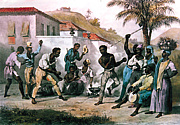
左の写真はフランスの画家Jean-Baptiste Debret (1768–1848)の著作「Voyage Pittoresque et Historique au Brésil」(1834-1839)の一枚「Négre vendeurs de volaille」(黒人家禽売り)です。カポエィラ(鳥籠)を頭に乗せた黒人が描かれ、左肩には呼び売りをするためのカリンバがさげられています。
右は、サン・パウロ美術館のコレクションの一枚で、イギリス人のHenry Chamberlain (1796–1843)が描いた「Quitandeiras da Lapa」(ラパ地区の青物屋)(1819-1820)です。中央には鶏が入ったカポエィラ(鳥籠)が描かれ、左端にはビリンバウを持った物売りも見られます。この時代ではカポエィラ(民俗芸能)でビリンバウが使われていた記録はない。
このような人物や場所でカポエィラ(民俗芸能)が暇つぶし、あるいは客を呼ぶために行われていたかもしれません。これは語源?とは異なり、カポエィラが都会的事象の娯楽遊技としての本質を強調しています。
Jean-Baptiste Debretの作品の一部ははこちら↓
http://www.s4ulanguages.com/debret2.html
http://www.s4ulanguages.com/debret3.html
Henry Chamberlainの作品は↓
http://www.masp.art.br/masp2010/acervo_detalheobra.php?id=655
http://hitchcock.itc.virginia.edu/Slavery/details.php?categorynum=6&categoryName=Slave%20Sales%20and%20Auctions:%20African%20Coast%20and%20the%20Americas&theRecord=72&recordCount=73
左の写真はフランスの画家Jean-Baptiste Debret (1768–1848)の著作「Voyage Pittoresque et Historique au Brésil」(1834-1839)の一枚「Négre vendeurs de volaille」(黒人家禽売り)です。カポエィラ(鳥籠)を頭に乗せた黒人が描かれ、左肩には呼び売りをするためのカリンバがさげられています。
右は、サン・パウロ美術館のコレクションの一枚で、イギリス人のHenry Chamberlain (1796–1843)が描いた「Quitandeiras da Lapa」(ラパ地区の青物屋)(1819-1820)です。中央には鶏が入ったカポエィラ(鳥籠)が描かれ、左端にはビリンバウを持った物売りも見られます。この時代ではカポエィラ(民俗芸能)でビリンバウが使われていた記録はない。
このような人物や場所でカポエィラ(民俗芸能)が暇つぶし、あるいは客を呼ぶために行われていたかもしれません。これは語源?とは異なり、カポエィラが都会的事象の娯楽遊技としての本質を強調しています。
Jean-Baptiste Debretの作品の一部ははこちら↓
http://www.s4ulanguages.com/debret2.html
http://www.s4ulanguages.com/debret3.html
Henry Chamberlainの作品は↓
http://www.masp.art.br/masp2010/acervo_detalheobra.php?id=655
http://hitchcock.itc.virginia.edu/Slavery/details.php?categorynum=6&categoryName=Slave%20Sales%20and%20Auctions:%20African%20Coast%20and%20the%20Americas&theRecord=72&recordCount=73
上記?のバントゥー諸言語説は、カポエィラのアフリカ発祥地説を強調しています。
これは単なる偶然の民族語源である可能性が高いですが、アンゴラの土着格闘技「N'golo」がカポエィラのルーツとして有力な候補とされるので、簡単に否定できる仮説ではありません。
Schneider, John T. (1991) Dictionary of African borrowings in Brazilian Portuguese, p104.
http://books.google.com/books?id=8POV2mEFgrQC&printsec=frontcover&hl=ja&source=gbs_navlinks_s#v=onepage&q=&f=false
N'goloなどに付いては↓
Desch-Obi, M. Thomas J. (2008), Fighting for honor: the history of African martial art traditions in the Atlantic world.
http://books.google.com/books?id=HNYwa1VeLIIC&printsec=frontcover&hl=ja&source=gbs_navlinks_s#v=onepage&q=&f=false
Assunção, M. Röhrig (2005), Capoeira: a history of an Afro-Brazilian martial art.
http://books.google.com/books?id=C5C7VP0ollYC&printsec=frontcover&hl=ja&source=gbs_slider_thumb#v=onepage&q=&f=false
これは単なる偶然の民族語源である可能性が高いですが、アンゴラの土着格闘技「N'golo」がカポエィラのルーツとして有力な候補とされるので、簡単に否定できる仮説ではありません。
Schneider, John T. (1991) Dictionary of African borrowings in Brazilian Portuguese, p104.
http://books.google.com/books?id=8POV2mEFgrQC&printsec=frontcover&hl=ja&source=gbs_navlinks_s#v=onepage&q=&f=false
N'goloなどに付いては↓
Desch-Obi, M. Thomas J. (2008), Fighting for honor: the history of African martial art traditions in the Atlantic world.
http://books.google.com/books?id=HNYwa1VeLIIC&printsec=frontcover&hl=ja&source=gbs_navlinks_s#v=onepage&q=&f=false
Assunção, M. Röhrig (2005), Capoeira: a history of an Afro-Brazilian martial art.
http://books.google.com/books?id=C5C7VP0ollYC&printsec=frontcover&hl=ja&source=gbs_slider_thumb#v=onepage&q=&f=false
>カサパ
Hey Caçapa! Carlos Eugenio Libano Soares is a defensor of the urban origin of capoeira and maybe was the researcher who introduced this hypothesis! The pics are close pictures of the "capoeira" carriers and they musical instruments.
>Besouro
ポル語でcapão=去勢された鶏ですから、たしかに闘鶏からの連想はおかしくないですね。上記に紹介した書籍でも実際にその説があげられています。
キジ科の鳥Odontophorus capueira(http://en.wikipedia.org/wiki/Spot-winged_Wood_Quail)の縄張り争いが語源となっている説もあります。
Hey Caçapa! Carlos Eugenio Libano Soares is a defensor of the urban origin of capoeira and maybe was the researcher who introduced this hypothesis! The pics are close pictures of the "capoeira" carriers and they musical instruments.
>Besouro
ポル語でcapão=去勢された鶏ですから、たしかに闘鶏からの連想はおかしくないですね。上記に紹介した書籍でも実際にその説があげられています。
キジ科の鳥Odontophorus capueira(http://en.wikipedia.org/wiki/Spot-winged_Wood_Quail)の縄張り争いが語源となっている説もあります。
>つきさん
たしかに、capãoにはポルトガル語とトゥピ語の意味があります。
Michaelis, Moderno Dicionário da Língua Portuguesa (1998-2009)
http://michaelis.uol.com.br/moderno/portugues/index.php?lingua=portugues-portugues&palavra=cap%E3o
↑によると、前者はラテン語のcaponeが語源で、去勢された家畜(主に山羊、豚や鶏)の意味。後者は、kaá=森、puã=円形で、まさに野原の真ん中の茂みです。
ブラジルの地名の多くはトゥピ語が使われ、Capão Redondoはサン・パウロ市郊外の特に治安が悪い地区として有名です。
トゥピ語のpûeraは名詞の過去形を示す接尾語で、「e」二重母音化によりpoeiraに変形した説があります。すなわちcapoeiraに変形したとのことです。(http://www.teses.usp.br/teses/disponiveis/8/8142/tde-14082006-093406/)
サン・パウロ市内の有名な公園の名前でIbirapuera(倒れた木)があります。今では普通に地名として認識されていますけど。
カサッパが投稿した動画ではeiraはeiroの変形で、carteiroはcarta(手紙)を運ぶ人=郵便集配人、leiteiroはleite(牛乳)を運ぶ人=牛乳配達人のように、capoeiroはcaápo(トゥピ語で籠)を運ぶ人=運搬人とされちます。
たしかに、capãoにはポルトガル語とトゥピ語の意味があります。
Michaelis, Moderno Dicionário da Língua Portuguesa (1998-2009)
http://michaelis.uol.com.br/moderno/portugues/index.php?lingua=portugues-portugues&palavra=cap%E3o
↑によると、前者はラテン語のcaponeが語源で、去勢された家畜(主に山羊、豚や鶏)の意味。後者は、kaá=森、puã=円形で、まさに野原の真ん中の茂みです。
ブラジルの地名の多くはトゥピ語が使われ、Capão Redondoはサン・パウロ市郊外の特に治安が悪い地区として有名です。
トゥピ語のpûeraは名詞の過去形を示す接尾語で、「e」二重母音化によりpoeiraに変形した説があります。すなわちcapoeiraに変形したとのことです。(http://www.teses.usp.br/teses/disponiveis/8/8142/tde-14082006-093406/)
サン・パウロ市内の有名な公園の名前でIbirapuera(倒れた木)があります。今では普通に地名として認識されていますけど。
カサッパが投稿した動画ではeiraはeiroの変形で、carteiroはcarta(手紙)を運ぶ人=郵便集配人、leiteiroはleite(牛乳)を運ぶ人=牛乳配達人のように、capoeiroはcaápo(トゥピ語で籠)を運ぶ人=運搬人とされちます。
- mixiユーザー
- ログインしてコメントしよう!
|
|
|
|
japoeirando 更新情報
-
最新のアンケート
-
まだ何もありません
-
japoeirandoのメンバーはこんなコミュニティにも参加しています


人気コミュニティランキング

- 1位
- 30代〜40代から友達作り【友活】
- 35753人

- 2位
- 一行で笑わせろ!
- 83248人
- 3位
- 暮らしを楽しむ
- 78112人