

 。
。


"Nanocarbon Superhydrophobic Surfaces created from Fullerene-Based Hierarchical Supramolecular Assemblies"
T. Nakanishi, T. Michinobu, K. Yoshida, N. Shirahata, K. Ariga, H. Möhwald, D. G. Kurth
Adv. Mater., 20, 443(2008).
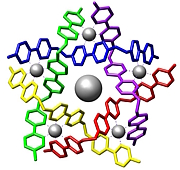
炭素系ナノ材料のフラーレンを用いて、表面にナノサイズのフレーク構造を持つ微粒子を作製し、これを基板上に敷き詰めた薄膜がハスの葉の様に水をはじく超撥水の機能を発現することを発見した。
Nanocarbon superhydrophobic surfaces (NCSSs) with a fractal morphology of the two-tier roughness on a nano- and microscopic scale are created from hierarchical, supramolecular objects, which are readily prepared by molecular assembly of a fullerene derivative bearing long aliphatic chains. The high durability of the fabricated fractal structures is derived from enhanced - and van der Waals interactions of fullerene and aliphatic chain moieties, respectively.
あまりにも錆びれたコミュニティーなので時折、面白そうな論文でもうpします。
誰かコメントください。
T. Nakanishi, T. Michinobu, K. Yoshida, N. Shirahata, K. Ariga, H. Möhwald, D. G. Kurth
Adv. Mater., 20, 443(2008).
炭素系ナノ材料のフラーレンを用いて、表面にナノサイズのフレーク構造を持つ微粒子を作製し、これを基板上に敷き詰めた薄膜がハスの葉の様に水をはじく超撥水の機能を発現することを発見した。
Nanocarbon superhydrophobic surfaces (NCSSs) with a fractal morphology of the two-tier roughness on a nano- and microscopic scale are created from hierarchical, supramolecular objects, which are readily prepared by molecular assembly of a fullerene derivative bearing long aliphatic chains. The high durability of the fabricated fractal structures is derived from enhanced - and van der Waals interactions of fullerene and aliphatic chain moieties, respectively.
あまりにも錆びれたコミュニティーなので時折、面白そうな論文でもうpします。
誰かコメントください。
|
|
|
|
コメント(6)
"Self-healing and thermoreversible rubber from supramolecular assembly"
P. Cordier, F. Tournilhac, C. Soulié-Ziakovic, L. Leibler
Nature, 451, 977(2008).
ゴムバンドは切れてしまったら、それでおしまい。もう1本用意しなくてはいけない。ところが、今週号に報告されている画期的な新材料は、ずいぶん異なる性質を示す。多重水素結合を形成する3種の官能基をもつ分子の会合により、鎖状部と架橋部の両方をもつ「超分子ゴム」が形成される。この超分子ゴムは、ゴム特有の性質、つまり元の長さの数倍に引き伸ばされても回復可能な伸長性を示す。だがこの系は、巨大分子からなる従来のゴムとは異なり、破断されたり切断されたりしても、室温で破断面どうしを合わせると自己修復が可能なのだ。この新材料は、脂肪酸と尿素という簡単な原料から合成でき、合成後は容易に再処理・再加工される。今回作られた超分子ゴムは、ひずみ回復が遅く、応力を受け続けると「変形(クリープ)」するが、出発原料を調節することによってさまざまな特性が実現できる。
Rubbers exhibit enormous extensibility up to several hundred per cent, compared with a few per cent for ordinary solids, and have the ability to recover their original shape and dimensions on release of stress. Rubber elasticity is a property of macromolecules that are either covalently cross-linked or connected in a network by physical associations such as small glassy or crystalline domains, ionic aggregates or multiple hydrogen bonds. Covalent cross-links or strong physical associations prevent flow and creep. Here we design and synthesize molecules that associate together to form both chains and cross-links via hydrogen bonds. The system shows recoverable extensibility up to several hundred per cent and little creep under load. In striking contrast to conventional cross-linked or thermoreversible rubbers made of macromolecules, these systems, when broken or cut, can be simply repaired by bringing together fractured surfaces to self-heal at room temperature. Repaired samples recuperate their enormous extensibility. The process of breaking and healing can be repeated many times. These materials can be easily processed, re-used and recycled. Their unique self-repairing properties, the simplicity of their synthesis, their availability from renewable resources and the low cost of raw ingredients (fatty acids and urea) bode well for future applications.
P. Cordier, F. Tournilhac, C. Soulié-Ziakovic, L. Leibler
Nature, 451, 977(2008).
ゴムバンドは切れてしまったら、それでおしまい。もう1本用意しなくてはいけない。ところが、今週号に報告されている画期的な新材料は、ずいぶん異なる性質を示す。多重水素結合を形成する3種の官能基をもつ分子の会合により、鎖状部と架橋部の両方をもつ「超分子ゴム」が形成される。この超分子ゴムは、ゴム特有の性質、つまり元の長さの数倍に引き伸ばされても回復可能な伸長性を示す。だがこの系は、巨大分子からなる従来のゴムとは異なり、破断されたり切断されたりしても、室温で破断面どうしを合わせると自己修復が可能なのだ。この新材料は、脂肪酸と尿素という簡単な原料から合成でき、合成後は容易に再処理・再加工される。今回作られた超分子ゴムは、ひずみ回復が遅く、応力を受け続けると「変形(クリープ)」するが、出発原料を調節することによってさまざまな特性が実現できる。
Rubbers exhibit enormous extensibility up to several hundred per cent, compared with a few per cent for ordinary solids, and have the ability to recover their original shape and dimensions on release of stress. Rubber elasticity is a property of macromolecules that are either covalently cross-linked or connected in a network by physical associations such as small glassy or crystalline domains, ionic aggregates or multiple hydrogen bonds. Covalent cross-links or strong physical associations prevent flow and creep. Here we design and synthesize molecules that associate together to form both chains and cross-links via hydrogen bonds. The system shows recoverable extensibility up to several hundred per cent and little creep under load. In striking contrast to conventional cross-linked or thermoreversible rubbers made of macromolecules, these systems, when broken or cut, can be simply repaired by bringing together fractured surfaces to self-heal at room temperature. Repaired samples recuperate their enormous extensibility. The process of breaking and healing can be repeated many times. These materials can be easily processed, re-used and recycled. Their unique self-repairing properties, the simplicity of their synthesis, their availability from renewable resources and the low cost of raw ingredients (fatty acids and urea) bode well for future applications.
- mixiユーザー
- ログインしてコメントしよう!
|
|
|
|
超分子 更新情報
-
最新のイベント
-
まだ何もありません
-
-
最新のアンケート
-
まだ何もありません
-
超分子のメンバーはこんなコミュニティにも参加しています

人気コミュニティランキング

- 1位
- 写真を撮るのが好き
- 209769人

- 2位
- 北海道日本ハムファイターズ
- 28023人
- 3位
- 暮らしを楽しむ
- 77852人