


|
|
|
|
コメント(27)
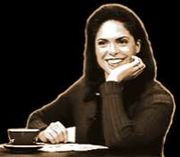
Cookie: How long does your morning routine take, from wake-up to out-the-door?
Soledad: Ohhhh I'm embarrassed to admit—less than five minutes! I throw on clothes, brush my teeth, and run out the door—hair a big mess, wearing jeans and boots, usually.
Cookie: How much sleep do you get each night?
Soledad: Not enough. The boys just started sleeping through the night, so it's gotten better. But I'd say six hours a night on a great night, and four to five most of the time.
Cookie: What are your guilty pleasures?
Soledad: Pralines and cream from Baskin Robbins (right around the corner from my apartment—how convenient!). I am a Murder, She Wrote freak. I eat a Snickers bar for breakfast every morning, and despite numerous efforts to quit drinking coffee, I drink a ton—I can't help it, I get up at 3 a.m.!
Cookie: So how many cups are we talking about?
Soledad: Well, I usually don't drink the full cup—I have a few sips and refill constantly while we're on the air. So I'd guess three cups in the morning. Then, no more caffeine.
Cookie: How do you stay on top of the news?
Soledad: I watch everything: All the competition in the morning, all the evening newscasts. And I read transcripts of interviews I'm interested in if I can't watch the whole show. The Internet has made it so easy to stay on top of the news. And I carry a couple of papers around in my handbag to read on the subway.
Cookie: What books are on your night table?
Soledad: Ha, this is a joke, right? If I didn't actually fall asleep trying to read for pleasure after I plow through my reading for work, I'd tackle Michael Eric Dyson's new book, Debating Race. And my girlfriend Veronica Chambers just wrote Kickboxing Geishas, and I'm reading that (not in bed, but when I commute anywhere). Both are great, great, great.
Cookie: How do you and your husband divide up the parenting responsibilities?
Soledad: We share. Everything. Really, the only "Brad" job is garbage at night, because I'm too tired to take it out. He likes to cook, but really can't during the week, so on weekends he makes feasts, and I clean up! I like doing the dishes. We are very much a team when it comes to discipline, and even when we disagree, we present a united front. I do the laundry. He can step over piles of toys; I tend to put them away.
Cookie: How many nights a week do you have dinner with your family?
Soledad: On a normal week, five at least. An abnormal week can be anything—I might not be eating dinner if I'm on the road. We almost always have family dinners on Saturday and Sunday, and the girls split the duty of saying grace. Although they tend to say, "I bless us oh Lord...."
Cookie: How many nights a week do you go out without the kids?
Soledad: This is another joke, right? I almost never go out for fun during the week. Maybe one night a week. On occasion I'll host an event, but I'll be home at 8:30. On Saturdays, Brad and I get a sitter and go out for a drink at the local bar to watch sports and just catch up.
Cookie: Do your children watch you on CNN?
Soledad: Yes, they watch. They are very interested in the stories—especially the tsunami and Hurricane Katrina. My daughter Sophia is in love with Bill Hemmer, who's on Fox now but was my partner not long ago. When he was on CNN, she'd scream if anyone blocked the television. She was very obsessed with Bill.
Cookie: What's the one thing you wish someone had told you before you had kids?
Soledad: How physically tough it is. I'm 40, and some days I feel 70. I pick up the boys so much—my back hurts, my arms hurt, my legs literally creak! I wish I'd known that I would never stop worrying about them. And if I'd known how much fun it was, I would have had kids earlier!
by http://www.cookiemag.com/magazine/2007/01/SCsoledad
Name: Soledad O'Brien
Position: Anchor, CNN's American Morning
Résumé: Before joining CNN in July 2003, anchored NBC's Weekend Today for three years, launched MSNBC's technology program, The Site in 1996. Joined NBC News in 1991 as a field producer.
Birthdate: September 19, 1966
Hometown: Smithtown, New York
Education: BA English & American Literature , Harvard University
Marital status: Married to investment banker Brad Raymond; the couple have four children (Sophia, 6, Cecilia, 4, and twins Jackson and Charlie, 2 ½)
First Section of the Sunday Times: "Real estate. I find real estate in Manhattan fascinating. I have to read all the profiles of the things that are for sale. I always compare my apartment which I bought four years ago; was it a good or bad deal? I also compare my apartment that I bought two apartments ago. Both were good deals. I was in the Flatiron (district) first and flipped it and made a ton of money; then the most recent one in Chelsea was a good deal — it was before Chelsea got cleaned up a little."
How would you say you've gotten to where you are?
It's truly a story of hard work and taking advantage of some really great opportunities. I think I have a reputation for being very persistent and attacking problems and things that I needed to personally work on whether it was interview style or how to become a better writer. In a way, it's comforting because it's not magic. It's going over things again and again and again.
What's the best thing you've ever done on air?
Probably my interview with Michael Brown from FEMA — "You're doing a heck of a job, Brownie." I remember after I did that interview, a girlfriend of mine, my first boss in TV, sent me a note and said it was the best interview I'd ever done.
Why?
Katrina hit on a Monday and it was on the Friday. (Brown) was laying out all the supplies that were coming to the victims and this was after we had seen the people at the convention center and heard all the reports about the looting. He was laying out all the things that were making their way to New Orleans and it just seemed a little bizarre that he was highlighting these big pluses when the question was, "Why five days later?" I think it was a good interview because it was actually the right tone and it captured a lot of the disbelief that a lot of people were feeling — Stop spinning us about how great the efforts are going when we can clearly see in the double box it's not going so well. On the one hand we were seeing "Brownie" and on the other hand, we're seeing people begging for water. To be highlighting all the successes FEMA was having seemed a little inappropriate.
How did your experience in New Orleans after Katrina stack up against other on location reporting you've done for other news stories?
We were literally shooting stories on our way to shoot stories. There were a lot of places we were getting to that nobody else was getting to, because logistically it was very hard. Emotionally, it was very tough to see some of those things. The tsunami was also a very devastating story to cover but there was so much response and the entire global community was focused on rebuilding. In New Orleans, it just felt like everybody was just sitting there waiting — it was a very tough story to capture on a lot of levels.
You've worked in both network and cable news. How do they compare from a career standpoint? Is there a difference in the way in which the job is done?
On paper, our show has fewer viewers than the show I did at Weekend Today, but anecdotally, we have so many more. I cannot walk out of my house without someone saying to me, "I watch you all the time on CNN" — and talking very knowledgably about the stories we cover. That really surprised me because on paper our audience is so much smaller. I think that's because we cover the news that's very relevant to people's lives, so in a way I think it makes a bigger impact. Because of that, I've really loved covering hard news stories. It's so much more interesting to me to show up in cargo pants and boots and sleep on the floor of an RV and be knee deep in a story. It's so much easier for me as a reporter than doing cooking or fashion segments. As a reporter, you're much more fulfilled when you can be on the ground and say, "Look at what we've discovered here."
In a lot of ways I've found there's a great freedom at CNN to go find a story that's breaking. You get a lot of support within the company. If you call in on a satellite phone and say, "I think I've got something here," that's it. Everybody is listening up and listening in. That's not for me — it's for all the correspondents. The first week I got here they handed me a little bag with a head lamp, a gas mask — at NBC you get the slicker and an NBC baseball cap. (Laughs)
What do you think of the media's coverage of Iraq and CNN's in particular?
I've been very proud of our coverage in Iraq. To watch our correspondents and see them flinch when there's a bomb going off and the fact that they don't run off screaming is remarkable. I could not do that. I think we're really solid. We're there every day. We have a live reporter updating us every day.
What about Iraq being labeled a "Civil War" in the media?
I don't think the media gets to decide it's a civil war. I don't think anybody needs me to tell them when I believe it's a civil war. I think it's up to me to ask the questions. What is the definition of a civil war? When, if it ever occurs, does Iraq need that definition? I think somebody declaring it a civil war because they've decided it's a civil war — I just don't think that's something I'd be comfortable with. (CNN) did not declare it a civil war. We have not declared it a civil war. I think it was NBC or maybe the LA Times that went first with that definition so I'd be interested in hearing why they felt they could declare it a civil war.
Any thoughts on how the media has been covering Katie Couric and her evening news broadcast?
It's been really fascinating how many stories focus on her outfits. That has been a little surprising to me. I think the American public truly does not care. I think people understand that you dress up like Peter Pan on Halloween because that's what The Today Show did. It's not indicative of what kind of journalist she is. For journalists to write about that was surprising because I don't think your average person is running around saying, "How can someone who dressed up as Peter Pan report hard hitting news?" I think journalists made a much bigger deal about it. I don't think people critique her outfits. I think journalists are way off on this.
Are the networks doing enough to promote a racially diverse workplace?
My answer is I think everybody could do more to hire more people of color. I truly believe you get a wider range of stories coming to you when you have a real diversity of who you're talking to in your editorial meeting. I think everybody could do a better job of that.
Mel Gibson's anti-Semitic comments when he was arrested this summer and Michael Richards' rantings at an LA comedy club in November both got a lot of media coverage focusing on public outrage. But afterwards, sales of the Seinfeld DVD skyrocketed and Gibson gets a standing ovation on The Tonight Show and his movie opens number one. What do you make of all that?
I think it's an interesting conversation. Both of them have said "I didn't mean it and it's not me speaking." I'm pretty confident if I were pulled over, I wouldn't be spewing racial epithets at the cop. I think clearly there's a conversation to be had about race in this country.
The Richards story was everywhere for days. Did it receive a disproportionate amount of coverage?
I thought it was an interesting story. There's clearly something going on. I would love to interview him. Outside of the apology — no one needs to apologize to me — it's not about that. I would like to know why. What's going on? I find that fascinating. I don't think (the coverage) was disproportionate. I think people talk about things as long as they're interesting.
You were on a recent cover of "Working Mother." What do you think of ABC News' handling of Elizabeth Vargas' pregnancy and how that became part of the story of her stepping down from her co-anchor position on the evening news?
What I resent the most out of all of that is the sense that all pregnant women or all women having children should all respond in the same way. One side says, "You should all suck it up and march on and make it work." The other side says, "You'd be a much better mother if you'd just stay home and raise those children." The truth is, for every person it's an individual decision. Elizabeth, I'm sure, has ten more reasons than we know about for the decision she made. It's so much more complicated than "good mommy, bad mommy."
How do you manage to do your job and raise four kids?
Some days I think, "Wouldn't it be nice to just stay home and bring everybody to school?" Then I spend a couple of days bringing everybody to school and I think, "Oh God, I can't wait to get back to the office. I exhausted." For most of us, you just figure it out. Some days you do more and some days you do less. I want to cover the big story but I also want to go to the sing-along at kindergarten. How do you balance? That, to me, is hard and I don't think people articulate that well yet.
Are you a tech geek?
No, Miles (O'Brien, co-anchor) is so I live vicariously through him. He's really into laser pointers so I'm getting him one for Christmas. I have the latest Blackberry and I love it. When I covered technology I learned a lot. Women are much more practical about their technology. I would never have a laser pointer but a Blackberry frees you up.
Do you miss anything about those early days doing that tech show (The Site) on MSNBC?
There are things I miss about it and things I don't. It's really hard to do a start-up, but there's something great about it because every idea is potentially a very cool idea. In that field, I felt like we were doing stories that someone would come back and look at in 30 years, because just by covering the digital revolution we were making news.
Diane Clehane is a contributing editor to mediabistro's FishbowlNY.com.
http://www.mediabistro.com/articles/cache/a9332.asp
あんまり普段聞けないような質問が沢山でおもしろい
- mixiユーザー
- ログインしてコメントしよう!
|
|
|
|
☆Soledad O'brien☆ 更新情報
-
最新のイベント
-
まだ何もありません
-
-
最新のアンケート
-
まだ何もありません
-
☆Soledad O'brien☆のメンバーはこんなコミュニティにも参加しています


人気コミュニティランキング

- 1位
- 30代〜40代から友達作り【友活】
- 35883人
- 2位
- 暮らしを楽しむ
- 78091人
- 3位
- 40歳以上のおじさん&おばさん
- 14781人