
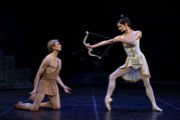

 )演目を教えていただいて、ありがとうございました。


|
|
|
|
コメント(8)
http://jp.youtube.com/watch?v=LX5Jm_7RYsM
動画投稿者の注釈
「Here is part 1/4 of a slightly abriged version of Marius Petipa's rarely seen 1896 demi-character ballet "Le Halte de cavalerie", performed in 1983 by the Maly/Mussorgsky Ballet of St. Petersburg.
Part 3 of my upload includes the rarely performed "Cavalry Halt Pas de deux".
Choreography - Marius Petipa, though it certainly contains Soviet-era revisions.
Music - Johann Armsheimer
Décor - Gennady Sotnikov
Costumes - Tatiana Ratner
Cast -
Theresa - Svetlana Vasilyeva
Marie - Tanya Borushina
Pierre - Andrei Yevdokimov
Colonel of Hussars - Vladimir Dolgallo
Captain of Hussars - Grigory Zamyal
Cornet of Lancers- Valery Pechersky
Contrary to popular belief, demi-character ballets such as this were Petipa's most common output. His ballets were always wonderful combinations of the character and classical canon, all of course used as a tool to ultimately tell the story.
Petipa created "Le Halte de cavalerie" for Pierina Legnani (the world's first Prima Ballerina Assoluta) who performed the role of Theresa, and his daughter Marie Petipa (the first Lilac Fairy in "The Sleeping Beauty") who performed the character role of Marie. The original cast also included the great premier danseur noble Pavel Gerdt as Pierre and Alfred Bekefi (the first Councilor Drosselmeyer in "The Nutcracker") as the Captain.
It is significant to note that the Sergeyev Collection, held in the Harvard University Library's Theatre Collection, contains Petipa's original choreography among the choreographic notation.」
http://jp.youtube.com/watch?v=MuBh3oMF4ho
 This clip includes the rarely performed "Cavalry Halt Pas de deux".
http://jp.youtube.com/watch?v=Wbq_S3mE4a8&feature=related
http://jp.youtube.com/watch?v=oJF6ol34i8g&feature=related
動画投稿者の注釈から
「NOTE - You might notice that the music that accompanies the final "danse générale" is also used for the coda of the so-called "La Fille mal gardée pas de deux" from the old Petipa/Ivanov/Gorsky/Hertel version of the ballet. The version of "La Fille mal gardée pas de deux" that is traditionally danced today at galas and ballet competitions is actually the creation of Alexander Gorsky, who utilized this piece from Armsheimer's music when he staged his version of the pas in the early 20th century.」
This clip includes the rarely performed "Cavalry Halt Pas de deux".
http://jp.youtube.com/watch?v=Wbq_S3mE4a8&feature=related
http://jp.youtube.com/watch?v=oJF6ol34i8g&feature=related
動画投稿者の注釈から
「NOTE - You might notice that the music that accompanies the final "danse générale" is also used for the coda of the so-called "La Fille mal gardée pas de deux" from the old Petipa/Ivanov/Gorsky/Hertel version of the ballet. The version of "La Fille mal gardée pas de deux" that is traditionally danced today at galas and ballet competitions is actually the creation of Alexander Gorsky, who utilized this piece from Armsheimer's music when he staged his version of the pas in the early 20th century.」
もんささん、
私は、今回はじめてこの曲を知りました。
マリインスキーによる復刻のようなんですが、キーロフはいろいろやってくれて楽しいですよね。
女性Va.はコンクールでも踊った方がいらっしゃるみたいです。
レノンさん、
ストーリーありがとうございます。
後に挙げた4つの動画は映像が古いな〜と思いましたが、踊りとしても中味充実してそうですね。
これからじっくり見てみますね。
ルジマートフは「レーニングラード国立バレエ団ミハイロフスキー劇場」の芸術監督で、トリプル・ビルの一つの演目にこの騎兵隊の休日を入れてたようです。
http://mikhailovsky.ru/london2008/
ここに、2枚写真が出ていました。
日本でも、公演でしているところがちょこちょこあるんですね。
- mixiユーザー
- ログインしてコメントしよう!
|
|
|
|
バレエ:この曲を知りたい 更新情報
-
最新のイベント
-
まだ何もありません
-
-
最新のアンケート
-
まだ何もありません
-
バレエ:この曲を知りたいのメンバーはこんなコミュニティにも参加しています


人気コミュニティランキング

- 1位
- 30代〜40代から友達作り【友活】
- 35859人
- 2位
- 暮らしを楽しむ
- 78105人
- 3位
- 食べ物写真をつい撮ってしまう人
- 20315人