
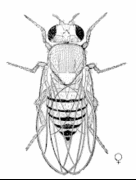


はじめましてでトピ立てさせていただきます。ショウジョウバエの面白そうな話題などがあったらご紹介下さい。とりあえず最近のネイチャーより2報。
Nature 441 (7094) (8 June 2006)
神経:ショウジョウバエの睡眠の促進におけるきのこ体の動的役割
A dynamic role for the mushroom bodies in promoting sleep in Drosophila p753
Jena L. Pitman, Jermaine J. McGill, Kevin P. Keegan and Ravi Allada
doi:10.1038/nature04739
神経:ショウジョウバエの睡眠は成虫のきのこ体によって制御されている
Sleep in Drosophila is regulated by adult mushroom bodies p757
William J. Joiner, Amanda Crocker, Benjamin H. White and Amita Sehgal
doi:10.1038/nature04811
|
|
|
|
コメント(16)
ネイチャーよりパーキンソン病関連で2つ。Advance online publication (AOP) として1ヶ月以上前に出ていましたが、リンク先の新聞記事がnatureコミュでちょっと話題に。
医学:ショウジョウバエPINK1突然変異体のミトコンドリア機能障害はparkinにより補完される
Mitochondrial dysfunction in Drosophila PINK1 mutants is complemented by parkin p1157
Jeehye Park, Sung Bae Lee, Sungkyu Lee, Yongsung Kim, Saera Song, Sunhong Kim, Eunkyung Bae, Jaeseob Kim, Minho Shong, Jin-Man Kim and Jongkyeong Chung
http://www.nature.com/nature/journal/v441/n7097/full/nature04788.html
医学:ショウジョウバエのpink1はミトコンドリアの機能に必要とされ、parkinと遺伝的に相互作用する
Drosophila pink1 is required for mitochondrial function and interacts genetically with parkin p1162
Ira E. Clark, Mark W. Dodson, Changan Jiang, Joseph H. Cao, Jun R. Huh, Jae Hong Seol, Soon Ji Yoo, Bruce A. Hay and Ming Guo
http://www.nature.com/nature/journal/v441/n7097/full/nature04779.html
http://japanese.yna.co.kr/service/article_view.asp?News_id=062006050301900
http://mixi.jp/view_bbs.pl?id=6944943&comm_id=113977
Neuron. Vol50(6)より、3本。
Essential Role of the Apoptotic Cell Engulfment Genes draper and ced-6 in Programmed Axon Pruning during Drosophila Metamorphosis
Takeshi Awasaki, Ryoko Tatsumi, Kuniaki Takahashi, Kunizo Arai, Yoshinobu Nakanishi, Ryu Ueda, and Kei Ito
The Drosophila Cell Corpse Engulfment Receptor Draper Mediates Glial Clearance of Severed Axons
Jennifer M. MacDonald, Margaret G. Beach, Ermelinda Porpiglia, Amy E. Sheehan, Ryan J. Watts, and Marc R. Freeman
Wlds Protection Distinguishes Axon Degeneration following Injury from Naturally Occurring Developmental Pruning
Eric D. Hoopfer, Todd McLaughlin, Ryan J. Watts, Oren Schuldiner, Dennis D.M. O'Leary, and Liqun Luo
神経回路網の形成過程における余分な繊維の除去、および、損傷後の修復過程で変性した神経繊維の除去の仕組みは普遍的なものである。
ショウジョウバエに攻撃性がある事自体知りませんでした。。
=-=-=-=-=-=-=-=-=-=
September, 2006
ショウジョウバエの攻撃性
実験生物種の攻撃行動に関する初めての包括的な分子解析結果を報告する論文がNature Geneticsの9月号に掲載される。神経科学研究所(米国カリフォルニア州サンディエゴ)のHerman DierickとRalph Greenspanは、Drosophila melanogaster(キイロショウジョウバエ)の攻撃行動を記録し、定量化するための実験系を独自に開発した。 D. melanogasterの実験室種のほとんどは、野生種に高頻度で見られる攻撃性を急速に失う。このことは、意図的に攻撃性を選択すれば実験室種の攻撃性を回復させられる可能性を示している。DierickとGreenspanは、『two-male arena assay』を開発した。この実験系では、複数の独立した「闘技場(arena)」が設置された実験チャンバーに20対の雄のD. melanogasterを入れ、いくつかの攻撃と関連するパラメータ(頻度、強度、闘争時間のトータルなど)についての評価した(映像、静止画像参照)。攻撃性の高かった雄は、ランダムに選ばれた雌と交配させ、それを20世代以上繰り返した。その最後の世代のD. melanogasterの攻撃性は、第一世代の30倍になっていた。 DierickとGreenspanは、攻撃性の高いD. melanogasterと低いD. melanogasterの間で発現量が有意に異なる約80種類の遺伝子を報告している。その一つであるCyp6a20は、変異すると、単独で攻撃行動に著しい影響を与えた。ここまでの実験データで一般論を導き出すことはできないが、今回の研究で用いられたアッセイや実験方法は、攻撃行動の遺伝解析にとっての新たな水準となるはずである。
空間軸に沿ったモルフォゲンの勾配が細胞の分化を決定するというのは分子発生学の基本的な概念の一つですが、この論文は時間軸に沿ったタンパク質の濃度勾配が神経分化に関与するという点で注目を集めています。
Gradients of the Drosophila Chinmo BTB-Zinc Finger Protein Govern Neuronal Temporal Identity
Sijun Zhu, Suewei Lin, Chih-Fei Kao, Takeshi Awasaki, Ann-Shyn Chiang, and Tzumin Lee
Cell, Vol 127, 409-422, 20 October 2006
Many neural progenitors, including Drosophila mushroom body (MB) and projection neuron (PN) neuroblasts, sequentially give rise to different subtypes of neurons throughout development. We identified a novel BTB-zinc finger protein, named Chinmo (Chronologically inappropriate morphogenesis), that governs neuronal temporal identity during postembryonic development of the Drosophila brain. In both MB and PN lineages, loss of Chinmo autonomously causes early-born neurons to adopt the fates of late-born neurons from the same lineages. Interestingly, primarily due to a posttranscriptional control, MB neurons born at early developmental stages contain more abundant Chinmo than their later-born siblings. Further, the temporal identity of MB progeny can be transformed toward earlier or later fates by reducing or increasing Chinmo levels, respectively. Taken together, we suggest that a temporal gradient of Chinmo (Chinmohigh → Chinmolow) helps specify distinct birth order-dependent cell fates in an extended neuronal lineage.
睡眠不足のショウジョウバエによい夢を
Nature Reviews Neuroscience 7, 830 (November 2006)
Ganguly-Fitzgeraldたちは、ショウジョウバエを使って経験、睡眠、可塑性の関係を調べた研究成果を報告した最新の論文の中で、あらかじめ社会経験を多く積んでおくと日中の睡眠時間が長くなるというプロセスについて説明している。興味深いのは、この影響を媒介したのが、長期記憶に関与する遺伝子とシグナル伝達経路だという点だ。(以下省略)
元記事はサイエンスです。
Waking Experience Affects Sleep Need in Drosophila
Ganguly-Fitzgerald et al. Science 313: 1775-1781
Sleep is a vital, evolutionarily conserved phenomenon, whose function is unclear. Although mounting evidence supports a role for sleep in the consolidation of memories, until now, a molecular connection between sleep, plasticity, and memory formation has been difficult to demonstrate. We establish Drosophila as a model to investigate this relation and demonstrate that the intensity and/or complexity of prior social experience stably modifies sleep need and architecture. Furthermore, this experience-dependent plasticity in sleep need is subserved by the dopaminergic and adenosine 3',5'-monophosphate signaling pathways and a particular subset of 17 long-term memory genes.
新たなトランスジェニックフライ作成法。利点として、大きなDNAフラグメントの挿入や挿入位置を予め特定できる、などがあります。パックマン。。
http://www.sciencemag.org/cgi/content/abstract/1134426
P[acman]: A BAC Transgenic Platform for Targeted Insertion of Large DNA Fragments in D. melanogaster
Koen J. T. Venken, Yuchun He, Roger A. Hoskins, Hugo J. Bellen
We describe a transgenesis platform for Drosophila melanogaster which integrates three recently-developed technologies: a conditionally amplifiable bacterial artificial chromosome (BAC), recombineering, and {phi}C31-mediated transgenesis. The BAC is maintained at low-copy number, facilitating plasmid maintenance and recombineering, but induced to high-copy number for plasmid isolation. Recombineering allows gap repair and mutagenesis in bacteria. Gap repair efficiently retrieves DNA fragments up to 133 kb from P1 or BAC clones. {phi}C31-mediated transgenesis integrates these large DNA fragments at specific sites in the genome, allowing rescue of lethal mutations in the corresponding genes. This transgenesis platform should greatly facilitate structure-function analyses of most Drosophila genes.
珍しくもmixiニュースでハエの話題が。
http://news.mixi.jp/view_news.pl?id=213907&media_id=4
一寸の虫にも魂?=ハエの「自発的意志」計測実験−米独研究チーム
=-=-=-=-=-=
オンライン科学・医学誌プロス・ワンに掲載された論文によれば、実験では、体の動きをコンピューターでデータ化する装置にショウジョウバエを入れて頭を固定。装置の内部はむらのない白色にし、ハエが視覚刺激を受けない環境をつくった。その結果、ハエは視覚刺激を受けていないにもかかわらず、羽や脚を激しく動かした。
その運動をコンピューターで解析したところ、極めて複雑ながら一定のパターンを持っており、研究チームは「ハエも自発的意志のための脳内メカニズムを持っていると考えられる」とした。
=-=-=-=-=-=
だそうです。
もとの論文はこれですね。http://www.plosone.org/
=-=-=-=-=-=
Order in Spontaneous Behavior
Alexander Maye, Chih-hao Hsieh, George Sugihara, Björn Brembs
Brains are usually described as input/output systems: they transform sensory input into motor output. However, the motor output of brains (behavior) is notoriously variable, even under identical sensory conditions. The question of whether this behavioral variability merely reflects residual deviations due to extrinsic random noise in such otherwise deterministic systems or an intrinsic, adaptive indeterminacy trait is central for the basic understanding of brain function. Instead of random noise, we find a fractal order (resembling Lévy flights) in the temporal structure of spontaneous flight maneuvers in tethered Drosophila fruit flies. Lévy-like probabilistic behavior patterns are evolutionarily conserved, suggesting a general neural mechanism underlying spontaneous behavior. Drosophila can produce these patterns endogenously, without any external cues. The fly's behavior is controlled by brain circuits which operate as a nonlinear system with unstable dynamics far from equilibrium. These findings suggest that both general models of brain function and autonomous agents ought to include biologically relevant nonlinear, endogenous behavior-initiating mechanisms if they strive to realistically simulate biological brains or out-compete other agents.
=-=-=-=-=-=
swissinfo - スイスで、ホモセクシャルを解明する研究
「ホモセクシャルのスイッチ」
http://tinyurl.com/yvw9ag
記事では「ミバエ」となっていますがショウジョウバエの話です。genderblindはわざわざ翻訳する必要はなかったでしょう。グリアが性行動に関与することを示したのが要点ですが、News & Viewsでは、「ホモセクシャル」という言葉が不適切に用いられていると辛辣なコメントもよせられています。
News and Views Nature Neuroscience 11, 8 - 10 (2008)
Glia and romance Joel D Levine
Drosophila courtship is a complex behavior. A new study shows that glia modulate neurotransmission to influence male preference, but the authors should have resisted the temptation to describe their results in tabloid language.
- mixiユーザー
- ログインしてコメントしよう!
|
|
|
|
Drosophila Love 更新情報
-
最新のイベント
-
まだ何もありません
-
-
最新のアンケート
-
まだ何もありません
-
Drosophila Loveのメンバーはこんなコミュニティにも参加しています


人気コミュニティランキング

- 1位
- 40歳以上のおじさん&おばさん
- 14781人

- 2位
- 30代〜40代から友達作り【友活】
- 35870人

- 3位
- 株式投資
- 65313人