


Tensais MC's が、今日の日本経済新聞の英語版The Nikkey Weekly でとりあげられていたので転載しますね。
The Nikkey Weekly 2008/1/28
-----------
- Community reaches out with helping hand -
As more Japanese-Brazilians who came to Japan for work have begun settling down here, new problems are emerging such as children who fail to attend local schools or become juvenile delinguents.
At one reformatory in the Kanto region around Tokyo, about a dozen out of some 100 residents are Japanese-Brazilians. They make up most of the reformatory's non-Japanese inmates. Masato Ninomiya, a professor at Sao Paulo University and a first-generation Japanese emigrant, estimates that about 10,000 out of around 40,000 Brazilian children of school age in Japan do not attend school, which is one reason for the high rate of juvenile delinquency.
According to Brazilian Ambassodor to Japan Andre Amado, many parents of the children who fail to go to school are too busy to take proper care of their kids. Those young Japanese-Brazilians feel isolated in a country where they cannot communicate in their mother tongue of Portuguese.
Facing such serious problems, the Japanese-Brazilian community has started to actively hlep its members reach solutions. yoshiko mori, 70, founded a nonprofit organization called Sabja to support Japanese-Brazilians. The second-generation emigrant and Cathoric sister visits Brazilian yourths in reformatories every month. She also organaizes events in regions with large Japanese-Brazilian populations such as Gunma and Shizuoka prefectures. She is always ready to listens to children who are struggling to find their place in Japanese society.
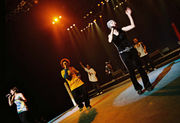
Hip-hop group Tensais MC's held a gig late last year in a club in Fujisawa, Kanagawa Prefecuture. Composed of Japanese-Brazilians and Japanese nationals, the group performs in both Japanese and Portuguese while its music is a combination of Brazilian samba and Japanese festival music.
Leader Beto, a second-generation emigrant whose real name is Roberto Ishikawa, came to Japan at the age of 17 to join his father who was a migrant worker. The group made its pro debut four years ago, but Brto, now 35, continues working at his daytime job as an electrician. he urges fellow Japanese-Brazilians to do the right thing to overcome difficulties they face in a country halfway around the world from their homeland.
"Japanese society has walls to keep us out, but we can break down those walls once we learn the language, and I shink we can create a new society," Beto said. Exchanges between Japan and Brazil can only deepen when young people from both countries meet and interact with one another.
The Nikkey Weekly 2008/1/28
-----------
- Community reaches out with helping hand -
As more Japanese-Brazilians who came to Japan for work have begun settling down here, new problems are emerging such as children who fail to attend local schools or become juvenile delinguents.
At one reformatory in the Kanto region around Tokyo, about a dozen out of some 100 residents are Japanese-Brazilians. They make up most of the reformatory's non-Japanese inmates. Masato Ninomiya, a professor at Sao Paulo University and a first-generation Japanese emigrant, estimates that about 10,000 out of around 40,000 Brazilian children of school age in Japan do not attend school, which is one reason for the high rate of juvenile delinquency.
According to Brazilian Ambassodor to Japan Andre Amado, many parents of the children who fail to go to school are too busy to take proper care of their kids. Those young Japanese-Brazilians feel isolated in a country where they cannot communicate in their mother tongue of Portuguese.
Facing such serious problems, the Japanese-Brazilian community has started to actively hlep its members reach solutions. yoshiko mori, 70, founded a nonprofit organization called Sabja to support Japanese-Brazilians. The second-generation emigrant and Cathoric sister visits Brazilian yourths in reformatories every month. She also organaizes events in regions with large Japanese-Brazilian populations such as Gunma and Shizuoka prefectures. She is always ready to listens to children who are struggling to find their place in Japanese society.
Hip-hop group Tensais MC's held a gig late last year in a club in Fujisawa, Kanagawa Prefecuture. Composed of Japanese-Brazilians and Japanese nationals, the group performs in both Japanese and Portuguese while its music is a combination of Brazilian samba and Japanese festival music.
Leader Beto, a second-generation emigrant whose real name is Roberto Ishikawa, came to Japan at the age of 17 to join his father who was a migrant worker. The group made its pro debut four years ago, but Brto, now 35, continues working at his daytime job as an electrician. he urges fellow Japanese-Brazilians to do the right thing to overcome difficulties they face in a country halfway around the world from their homeland.
"Japanese society has walls to keep us out, but we can break down those walls once we learn the language, and I shink we can create a new society," Beto said. Exchanges between Japan and Brazil can only deepen when young people from both countries meet and interact with one another.
|
|
|
|
|
|
|
|
TENSAI 'S MC's 更新情報
-
最新のアンケート
-
まだ何もありません
-
TENSAI 'S MC'sのメンバーはこんなコミュニティにも参加しています


人気コミュニティランキング

- 1位
- 千葉 ロッテマリーンズ
- 37120人

- 2位
- 暮らしを楽しむ
- 77986人

- 3位
- 30代〜40代から友達作り【友活】
- 34606人