


出典: フリー百科事典『ウィキペディア(Wikipedia)』
http://
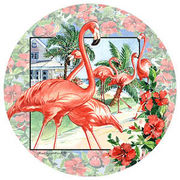
フラミンゴ(Flamingo)とはフラミンゴ目フラミンゴ科に属する
鳥の総称である。非常に長い脚と首を持つ大型の鳥である。
【分布】
アフリカ、南ヨーロッパ、中南米の塩湖や干潟に生息する。
塩湖やアルカリ性の湖といった特殊な環境に適応しており、
数千羽から百万羽程度の巨大な群れを形成する。
【形態と生態】
体色は淡いピンク色から鮮やかに紅色をしている。
この色はフラミンゴの餌である藍藻類の色素によるものである。
動物園で飼育する場合、飼料に色素を添加する事で羽色を維持している。
クチバシは中央部で急角度で下に曲がり、「へ」の字状の形状をしている。
クチバシの縁にはラメラと呼ばれるヒゲ状の組織があり、
これで水中の藍藻類や小動物を漉しとって食料としている。
ノドにある腺からフラミンゴミルクと呼ばれる栄養豊富な分泌液を出す。
これをヒナに口移しで与える事で子育てをする。
同様な例として、ピジョンミルクで子育てをするハトが挙げられる。
母乳を分泌する哺乳類以外でこのような子育てをするのは珍しい。
フラミンゴの舌は人間に対しては、強心作用を齎す。
ちなみに水辺にいる時片足で立っているのは
水に体温を奪われにくくするためだと言われている。
【分類】
フラミンゴ目はフラミンゴ科の6種からなる小さなグループである。
【フラミンゴの種】
Phoenicopterus ruber, en:Greater Flamingo, オオフラミンゴ
Phoenicopterus minor, en:Lesser Flamingo, コフラミンゴ
Phoenicopterus ruber, en:Caribbean Flamingo, ベニイロフラミンゴ
Phoenicopterus chilensis, en:Chilean Flamingo, チリーフラミンゴ
Phoenicopterus andinus, en:Andean Flamingo, アンデスフラミンゴ
Phoenicopterus jamesi, en:James's Flamingo, コバシフラミンゴ
【その他】
フラミンゴ(Flamingo)という名前はラテン語で炎を意味する
flammaに由来しているとされる。
フラミンゴを輸送するときは、動き回る事による体力の消耗を防ぐため、
パンストにくるんで頭だけ出す状態にする。
時に「世界一不味い鳥」と形容されることがあるが、
現在ではワシントン条約で保護されているため
一般現代人に味の真偽を知る術は無い。
…………フラミンゴって不味いんですね…@(;・ェ・)@/ 初耳!
|
|
|
|
コメント(3)
【オオフラミンゴ(ヨーロッパフラミンゴ):Phoenicopterus roseus】
英語名=Greater Flamingo
http://en.wikipedia.org/wiki/Greater_Flamingo
The Greater Flamingo (Phoenicopterus roseus) is the most
widespread species of the flamingo family.
It is found in parts of Africa, southwest Asia (including Turkey),
southern Asia (coastal regions of India) and southern Europe
(including Spain, Cyprus, Portugal, and the Camargue region of France).
Some populations are short distance migrants.
A single bird was seen on North Keeling Island (Cocos (Keeling)
Islands) in 1988.
This is a large species, averaging 120-140cm tall, and is closely
related to the Caribbean Flamingo and Chilean Flamingo,
with which it is sometimes considered conspecific.
Like all flamingos, this species lays a single chalky-white egg
on a mud mound.
Most of the plumage is pinkish-white, but the wing coverts are
red and the primary and secondary flight feathers are black.
The bill is pink with a restricted black tip, and the legs are
entirely pink. The call is a goose-like honking.
✄ฺ--------- キ ---- リ ---- ト ---- リ ------------
オオフラミンゴはフラミンゴの種の中でも生息地が最も広範囲に及び、
アフリカの一部やトルコを含む南西アジア、南アジア(インド沿岸地域)
そしてスペイン、キプロス、ポルトガル、フランスのカマルグ地域を含む
南ヨーロッパに生息している。
いくつかの群は短距離の渡り鳥だが、一羽が1988年に北キーリング諸島
(ココス諸島)で発見された。
この種は大きく全長平均120−140cmで、ベニイロフラミンゴや
チリーフラミンゴと近く関連付けられている。
他のフラミンゴと同様に、この種もチョークのような白い卵を一つ
ぬかるみの泥の盛り上がりに産む。
羽はほぼピンクっぽい白色だが、翼の雨覆羽は赤色で風切羽は黒色。
くちばしは先端が黒いピンク色で足は全体的にピンク。
鳴き声はガチョウに似ている。
適当な訳ですみません…ヾ(;→㉨←)ノ
【コフラミンゴ:Phoenicopterus minor】
英語名=Lesser Flamingo
http://en.wikipedia.org/wiki/Lesser_Flamingo
The Lesser Flamingo (Phoenicopterus minor) is a species in the
flamingo family of birds which occurs in Africa (principally
in the Great Rift Valley), across to Pakistan and northwest India.
It is the smallest and most numerous flamingo,
probably numbering up to two million individual birds.
In Africa, where they are most numerous, the Lesser Flamingos breeds
principally on the highly caustic Lake Natron in Northern Tanzania.
Like all flamingos, they lay a single chalky white egg on mounds
they build of mud. Most of the plumage is pinkish white.
Chicks join creches soon after hatching, sometimes
numbering over a hundred thousand individuals.
The creches are marshalled by a few adult birds who lead them
by foot to fresh water, a journey that can reach over 20 miles.
The clearest difference between this species and Greater Flamingo,
the only other Old World species, is the much more extensive
black on the bill. Size is less helpful unless the species are
together, since the sexes of each species also differ in height.
This species feeds primarily on Spirulina, a cyanobacteria
which grows only in very alkaline lakes.
Although blue-green in colour, the bacteria contains the
phtotosynthetic pigments that gives the birds their pink colour.
Their deep bill is specialised for filtering tiny food items.
Lesser Flamingos are predated on by a variety of species
including Marabou Storks, baboons, African Fish Eagles and jackals.
The population in the two key east African lakes, Nakuru and
Bogoria, have been adversely affected in recent years by
suspected heavy metal poisoning.
The Lesser Flamingo is one of the species to which the Agreement
on the Conservation of African-Eurasian Migratory Waterbirds
(AEWA) applies.
✄ฺ--------- キ ---- リ ---- ト ---- リ ------------
コフラミンゴはフラミンゴ科の中でアフリカ(主にグレート
リフトバレー)からパキスタンや北西インドにかけて生息し
最も体が小さく最も数が多い種である。(総計約200万羽)
最も生息数の多いアフリカでは、コフラミンゴは主に
非常に苛性であるタンザニア北部のナトロン湖で繁殖する。
他のフラミンゴと同様に、この種もチョークのような白い卵を一つ
ぬかるみに泥を盛り上げた上に産む。
ヒナは孵化するとその数100,000羽になることもあるヒナの集団に入り
20マイルに及ぶこともある距離を大人のフラミンゴに先導され
水場まで歩く。
コフラミンゴとオオフラミンゴの最も大きな違いは、コフラミンゴの方が
くちばしの黒い部分が広範囲にわたっていることである。
オスとメスのサイズも異なるため、大きさで見分けるには
2種ともが一緒にいるのを見ない限り容易ではない。
この種は主にスピルリナという、非常にアルカリ性の強い湖で育つ
藍藻を常食としている。このバクテリアは青っぽい緑色にも関わらず
光合成色素を含んでいるため、フラミンゴをピンク色にする。
フラミンゴの奥行きの深いくちばしは、小さなエサを濾過しやすいように
出来ている。
コフラミンゴはヒヒやサンショクウミワシジャッカルを含む
様々な種に捕食されることもある。
東アフリカのナクル湖とボゴリア湖の群れは近年、
重金属汚染により有害な影響を受けている。
コフラミンゴはアフリカ・ユーラシア渡り性水鳥の保全に関する協定が
適応される種のうちの一つである。
【ベニイロフラミンゴ(カリビアンフラミンゴ):Phoenicopterus ruber】
英語名=Caribbean Flamingo
http://en.wikipedia.org/wiki/Caribbean_Flamingo
The Caribbean Flamingo (Phoenicopterus ruber) is a large
species of flamingo closely related to the Greater Flamingo and
Chilean Flamingo, with which it is sometimes considered conspecific.
The Caribbean Flamingo breeds in the Galapagos Islands,
coastal Colombia and Venezuela and nearby islands, the Yucatán
Peninsula of Mexico, and in the northern Caribbean in the Bahamas,
Hispaniola, Cuba and Turks and Caicos.
Most sightings in southern Florida are usually considered to be
escapees, although at least one bird banded as a chick in the
Yucatán Peninsula has been sighted in Everglades National Park,
and others may be genuine wanderers from Cuba.
The habitat is similar to that of its relatives, including saline
lagoons, mudflats and shallow brackish coastal or inland lakes.
Like all flamingos, it lays a single chalky white egg on a
mud mound.
The Caribbean Flamingo is 120–140 cm in length; males weigh
2.8 kg and females 2.2 kg. Most of the plumage is pink,
giving rise to its earlier name of Rosy Flamingo and
differentiating adults from the much paler European species.
The wing coverts are red, and the primary and secondary flight
feathers are black.
It is the only flamingo which naturally occurs in North America.
The bill is pink with a restricted black tip, and the legs are
entirely pink. The call is a goose-like honking.
The Caribbean Flamingo is one of the species to which the
Agreement on the Conservation of African-Eurasian Migratory
Waterbirds (AEWA) applies.
✄ฺ--------- キ ---- リ ---- ト ---- リ ------------
ベニイロフラミンゴは、オオフラミンゴやチリーフラミンゴと
近く関連付けられる大型の種である。
ベニイロフラミンゴはガラパゴス諸島やコロンビア沿岸、
ベネズエラ周辺の諸島やメキシコのユカタン半島、
そしてバハマやイスパニョーラ島、キューバ、タークス・ケイコス諸島
などの北カリブ海地域に生息している。
塩分を含んだ池や沿岸の浅い泥地に住むなど、他の種と似たような
習性を持つ。また他のフラミンゴと同様、この種もチョークのような
白い卵を一つぬかるみの泥に産む。
ベニイロフラミンゴは全長訳120−140cmで、オスは約2.8kg、
メスは約2.2kg。羽はほぼ薔薇色のピンクで、それよりずっと色の白い
ヨーロッパフラミンゴと区別されている。
雨覆羽は赤で、風切羽は黒色。
北アメリカに野生として生息する唯一の種。
くちばしは先端が黒いピンク色で足は全体的にピンク。
鳴き声はガチョウに似ている。
ベニイロフラミンゴはアフリカ・ユーラシア渡り性水鳥の保全に関する協定が
適応される種のうちの一つである。
疲れて訳がさらに適当になってきてる…。
すみません……@(;・ェ・)@/
- mixiユーザー
- ログインしてコメントしよう!
|
|
|
|
フラミンゴ ♥ アミーゴ 更新情報
-
最新のイベント
-
まだ何もありません
-
-
最新のアンケート
-
まだ何もありません
-
フラミンゴ ♥ アミーゴのメンバーはこんなコミュニティにも参加しています


人気コミュニティランキング

- 1位
- 30代〜40代から友達作り【友活】
- 35887人

- 2位
- 暮らしを楽しむ
- 78095人

- 3位
- 40歳以上のおじさん&おばさん
- 14783人