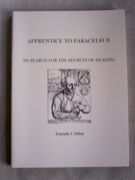


Paracelsus was born and raised in Switzerland, of a Swabian (Wilhelm Bombast von Hohenheim) chemist and physician father and a Swiss mother. As a youth he worked in nearby mines as an analyst. At the age of 16 he started studying medicine at the University of Basel, later moving to Vienna. He gained his doctorate degree from the University of Ferrara.[2]
He later journeyed to Egypt, Arabia, the Holy Land, Constantinople[citation needed], Lisbon, Spain, and England[1] seeking alchemists and physicians from whom to learn. He pursued medical treatments that were considered ludicrous in the Western world. Paracelsus was the disseminator in Europe of the medieval Islamic alchemists. [2] Instead of pouring boiling oil onto wounds to cauterize them; or if they were on a limb, to let them become gangrenous and then to amputate the limb, Paracelsus learned that wounds would heal themselves if allowed to drain and prevented from becoming infected. On his return to Europe, his knowledge of these treatments won him fame.
Paracelsus rejected Gnostic traditions, but kept much of the Hermetic, neoplatonic, and Pythagorean philosophies from Ficino and Pico della Mirandola; however, Hermetical science had so much Aristotelian theory that his rejection of Gnosticism was practically meaningless. In particular, Paracelsus rejected the magic theories of Agrippa and Flamel; Paracelsus did not think of himself as a magician and scorned those who did, though he was a practicing astrologer, as were most, if not all of the university-trained physicians working at this time in Europe. Astrology was a very important part of Paracelsus' medicine. In his Archidoxes of Magic Paracelsus devoted several sections to astrological talismans for curing disease, providing talismans for various maladies as well as talismans for each sign of the Zodiac. He also invented an alphabet called the Alphabet of the Magi, for engraving angelic names upon talismans.
Paracelsus pioneered the use of chemicals and minerals in medicine.
He used the name "zink" for the element zinc in about 1526, based on the sharp pointed appearance of its crystals after smelting and the old German word "zinke" for pointed. He used experimentation in learning about the human body. His hermetical views were that sickness and health in the body relied on the harmony of man, the microcosm, and Nature, the macrocosm. He took an approach different from those before him, using this analogy not in the manner of soul-purification but in the manner that humans must have certain balances of minerals in their bodies, and that certain illnesses of the body had chemical remedies that could cure them. (Debus & Multhauf, p.6-12)
He summarized his own views: "Many have said of Alchemy, that it is for the making of gold and silver. For me such is not the aim, but to consider only what virtue and power may lie in medicines." (Edwardes, p.47) (also in: Holmyard, Eric John. Alchemy. p. 170)
Indeed, the remnants of alchemical traditions can still be seen in modern medicine. For instance, the Caduceus has been adopted as the prime symbol of western medicine.
Paracelsus gained a reputation for being arrogant, and soon garnered the anger of other physicians in Europe. He held the chair of medicine at the University of Basel for less than a year; while there his colleagues became angered by allegations that he had publicly burned traditional medical books. He was forced from the city after having legal trouble over a physician's fee he sued to collect.
He then wandered Europe, Africa and Asia Minor, in the pursuit of hidden knowledge. He revised old manuscripts and wrote new ones, but had trouble finding publishers. In 1536, his Die grosse Wundartzney (The Great Surgery Book) was published and enabled him to regain fame.
He died in 1541 in Salzburg, and was buried according to his wishes in the cemetery at the church of St Sebastian in Salzburg. His remains are now located in a tomb in the porch of the church.
After his death, the movement of Paracelsianism was seized upon by many wishing to subvert the traditional Galenic physick- and thus did his therapies become more widely known and used.
His motto was "alterius non sit qui suus esse potest" which means "let no man belong to another that can belong to himself".
< by Wikipedia >
He later journeyed to Egypt, Arabia, the Holy Land, Constantinople[citation needed], Lisbon, Spain, and England[1] seeking alchemists and physicians from whom to learn. He pursued medical treatments that were considered ludicrous in the Western world. Paracelsus was the disseminator in Europe of the medieval Islamic alchemists. [2] Instead of pouring boiling oil onto wounds to cauterize them; or if they were on a limb, to let them become gangrenous and then to amputate the limb, Paracelsus learned that wounds would heal themselves if allowed to drain and prevented from becoming infected. On his return to Europe, his knowledge of these treatments won him fame.
Paracelsus rejected Gnostic traditions, but kept much of the Hermetic, neoplatonic, and Pythagorean philosophies from Ficino and Pico della Mirandola; however, Hermetical science had so much Aristotelian theory that his rejection of Gnosticism was practically meaningless. In particular, Paracelsus rejected the magic theories of Agrippa and Flamel; Paracelsus did not think of himself as a magician and scorned those who did, though he was a practicing astrologer, as were most, if not all of the university-trained physicians working at this time in Europe. Astrology was a very important part of Paracelsus' medicine. In his Archidoxes of Magic Paracelsus devoted several sections to astrological talismans for curing disease, providing talismans for various maladies as well as talismans for each sign of the Zodiac. He also invented an alphabet called the Alphabet of the Magi, for engraving angelic names upon talismans.
Paracelsus pioneered the use of chemicals and minerals in medicine.
He used the name "zink" for the element zinc in about 1526, based on the sharp pointed appearance of its crystals after smelting and the old German word "zinke" for pointed. He used experimentation in learning about the human body. His hermetical views were that sickness and health in the body relied on the harmony of man, the microcosm, and Nature, the macrocosm. He took an approach different from those before him, using this analogy not in the manner of soul-purification but in the manner that humans must have certain balances of minerals in their bodies, and that certain illnesses of the body had chemical remedies that could cure them. (Debus & Multhauf, p.6-12)
He summarized his own views: "Many have said of Alchemy, that it is for the making of gold and silver. For me such is not the aim, but to consider only what virtue and power may lie in medicines." (Edwardes, p.47) (also in: Holmyard, Eric John. Alchemy. p. 170)
Indeed, the remnants of alchemical traditions can still be seen in modern medicine. For instance, the Caduceus has been adopted as the prime symbol of western medicine.
Paracelsus gained a reputation for being arrogant, and soon garnered the anger of other physicians in Europe. He held the chair of medicine at the University of Basel for less than a year; while there his colleagues became angered by allegations that he had publicly burned traditional medical books. He was forced from the city after having legal trouble over a physician's fee he sued to collect.
He then wandered Europe, Africa and Asia Minor, in the pursuit of hidden knowledge. He revised old manuscripts and wrote new ones, but had trouble finding publishers. In 1536, his Die grosse Wundartzney (The Great Surgery Book) was published and enabled him to regain fame.
He died in 1541 in Salzburg, and was buried according to his wishes in the cemetery at the church of St Sebastian in Salzburg. His remains are now located in a tomb in the porch of the church.
After his death, the movement of Paracelsianism was seized upon by many wishing to subvert the traditional Galenic physick- and thus did his therapies become more widely known and used.
His motto was "alterius non sit qui suus esse potest" which means "let no man belong to another that can belong to himself".
< by Wikipedia >
|
|
|
|
|
|
|
|
<Paracelsus> 更新情報
-
最新のトピック
-
最新のイベント
-
まだ何もありません
-
-
最新のアンケート
-
まだ何もありません
-